


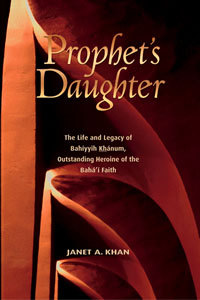

Prophet's Daughter examines the extraordinary life of Bahiyyih Khánum (1846-1932), the daughter of Bahá'u'lláh, founder of the Bahá'í Faith. From the mid-nineteenth century to the early twentieth century, when women in the Middle East were largely invisible, deprived of education, and without status in their communities, Bahiyyih Khánum was an active participant in the religion's turbulent early years and contributed significantly both to the development of its administrative structure and to its emergence as a worldwide faith community. Her appointment to head the Bahá'í Faith during a critical period of transition stands unique in religious history.
Bahiyyih Khánum's response to the events in her life despite some eight decades of extreme hardship illustrates her ability to transcend the social and cultural constraints of the traditional Muslim society in which she lived. Optimistic and resilient in the face of relentless persecution and uncertainty, practical and resourceful by nature, she embraced change, took action, and looked to the future. The legacy of her life offers an inspiring model for thoughtful women and men who seek creative ways to deal with social change and the pressures of contemporary life.
Bahiyyih Khánum's response to the events in her life despite some eight decades of extreme hardship illustrates her ability to transcend the social and cultural constraints of the traditional Muslim society in which she lived. Optimistic and resilient in the face of relentless persecution and uncertainty, practical and resourceful by nature, she embraced change, took action, and looked to the future. The legacy of her life offers an inspiring model for thoughtful women and men who seek creative ways to deal with social change and the pressures of contemporary life.


Not Entirely What I Thought
This is a meticulously researched book, but most of it is not directly about Bahiyyih Khanum herself, since very little is known about her day-to-day life in the Holy Household. The author was able to make some educated guesses, but because of the time's culture and The Greatest Holy Leaf's own humility, there are just so many details that remain unknown. A good portion of the book is devoted to the Greatest Holy Leaf's work in helping to break the gender barriers that existed in the early Baha'i communities, particularly in Iran. There is also a good deal of content about her support for the Master, particularly when he was away from Haifa for extended periods, and about the Guardian, her relationship with him, her assistance and love for him during the early days of his ministry, and the rise of the Baha'i Administrative Order. I was just more hopeful about discovering details about her life as a woman, and her help to her mother and sister-in-law during their exiles.